
Skip to content
Est. 2026

Full-Stack Engineer at Moat

Andrew Higgins

Full-Stack Engineer & Team Lead at Moat

Flutter · Go · PostgreSQL · AI Systems

A problem-solver who ships. I build the pipelines, data models, and AI systems behind a facility-intelligence platform, and I lead the team that ships them.

Portrait of Andrew Higgins
Fig. 1.1 · Andrew Higgins

In This Edition

  1. About Me 01
  2. Projects 02
  3. Experience 03
  4. Get In Touch 04

About Me

Section 01

I'm a full-stack engineer and team lead at Moat, where I work across Flutter, Go, and PostgreSQL to turn the messy physical reality of a building (thousands of pieces of equipment, each with a placard and a story) into data a facilities team can actually plan against. My work runs from onboarding pipelines and enterprise data imports to the AI classification systems behind the platform's capital planning.

Before Moat, I built full-stack tooling and programmed industrial HVAC controllers for BYU's AC Shop: web interfaces over complex SQL databases, and control logic for the systems that keep a campus running. That grounding in real hardware and non-technical users still shapes how I build software.

Prior to my engineering studies, I spent two years in Santiago, Chile as a full-time missionary for The Church of Jesus Christ of Latter-day Saints. There I became fluent in Spanish, trained new missionaries and led a team of five peers. This experience honed my leadership, communication, and goal-setting skills in a cross-cultural environment. Whether I'm coaching a swim team, teaching piano, or architecting a cloud application, I thrive on mentoring others and building effective, collaborative teams.

I care most about the unglamorous work that makes a product trustworthy: clean data models, deploys that don't break, and CI that catches the mistake before a customer does.

Technical Skills

Languages

Go Dart Python Java C++ SQL JavaScript HTML/CSS x86-64 Assembly MATLAB

Frameworks & Libraries

Flutter Flask Django Requests BeautifulSoup Pygame Tkinter Pillow Librosa Numpy SciPy Matplotlib

Tools & Platforms

PostgreSQL GitHub Actions (CI/CD) Protobuf/gRPC AWS Git/GitHub VS Code Linux SQL Server KiCad BLE STM32CubeMX Tridium (N4, AX) Delta Enteliweb Docker Raspberry Pi ESP32 systemd POSIX Threads GDB/objdump Makefiles Cloudflare Pages/R2 Decap CMS

Numerical & Signal Processing

SVD, PCA, and least squares regression; eigenvalue and Markov methods; Gram-Schmidt orthogonalization, LU decomposition, and Jacobi and Gauss-Seidel iterative solvers. Time-series and audio feature extraction, and on-device inference on embedded targets.

Education

Computer Engineering

Brigham Young University

Est. April 2028 · GPA 3.85

Contribution Activity

contributions

in the last year

Contributions per day over the last year.
@higg22-git Less More

Projects

Section 02
No. 01 Rev. 1 In Bring-Up
The populated Project Atlas board, showing the STM32 microcontroller, CAN transceivers, and USB-C debug port
Fig. 2.1 · Four-layer control board

Project Atlas

A four-layer STM32 control board built from scratch to replace the electronics controlling BYU's Formula SAE electric race car. The full manufacturing package is released and the first revision is fabricated and in hand. That board does not work yet, so the project is still open: rev 1 is where the 12 V rail died, and the fix belongs to rev 2.

  • Designed the power tree: a fused 12 V input, a synchronous buck down to 5 V, and an LDO to 3.3 V.
  • Six switched outputs off the STM32's GPIO: two 12 V high-side channels using PMOS switches with NMOS gate drivers, two open-drain 5 V channels, and two logic-level 3.3 V channels, with ADC sense on the low-voltage rails.
  • Three independent FDCAN buses over TJA1051 transceivers, plus USB-C debug serial through a CP2102N bridge with ESD protection.
  • Brought the first board up and traced a dead 12 V rail to a ground test point whose barrel crossed the split power plane.
  • Released the full manufacturing package (four-layer gerbers, BOM, and pick-and-place) and set up the Git workflow a four-person team used to collaborate in KiCad.
KiCad STM32 C++ FDCAN Power Electronics
No. 02 SIOY 2026
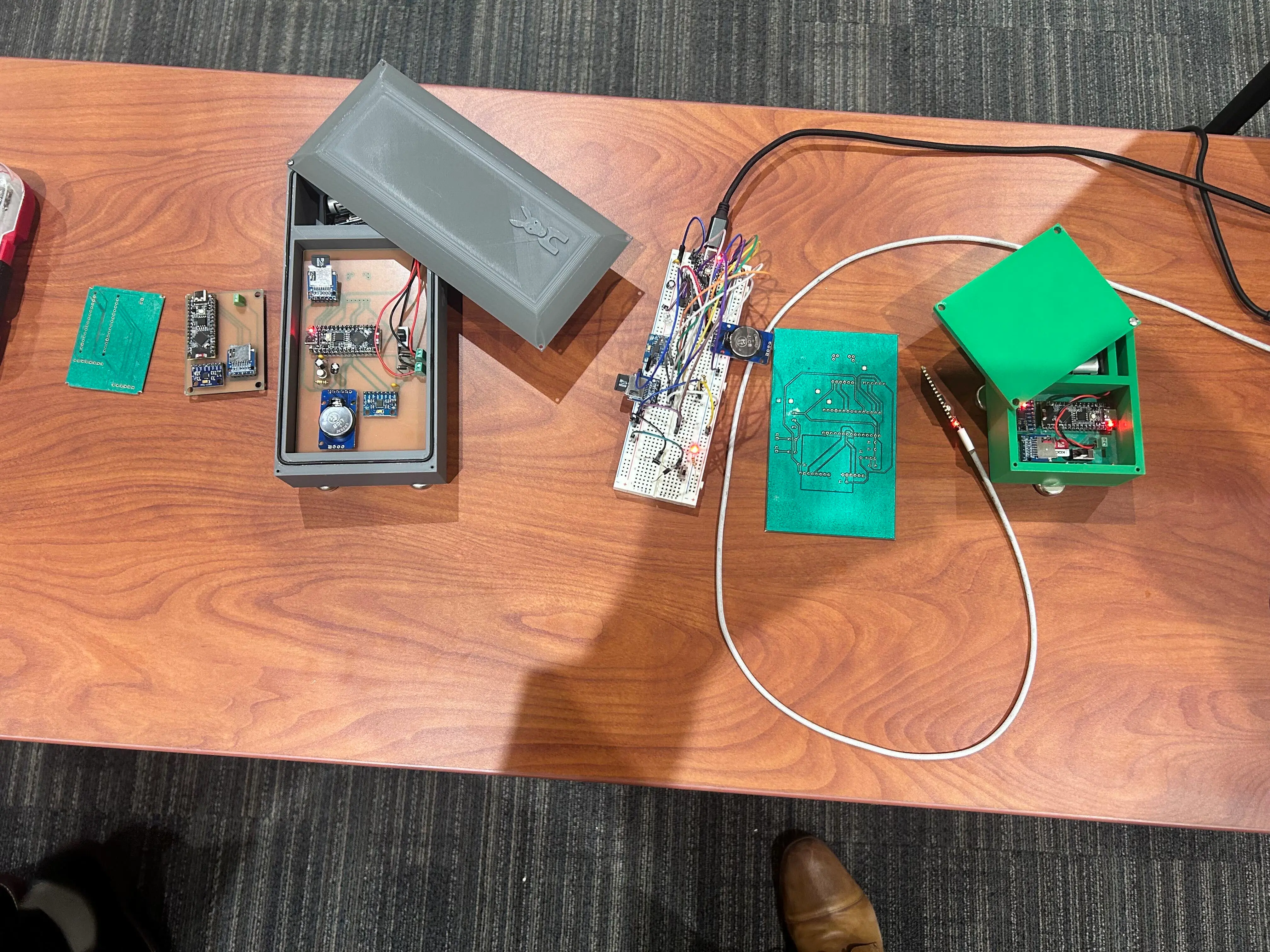
The Outlier Node sensor in its printed enclosure, next to the bare board
Fig. 2.2 · Sensor and enclosure

Outlier Node

A battery-powered vibration sensor for machinery that has no network. It runs a machine-learning model on the device itself and sends only the verdict, not raw data, aiming at under $100 against commercial monitors that start around $275. Built with one teammate and shown at BYU's Student Innovator of the Year showcase.

  • Designed the full circuit and PCB in KiCad (ESP32 Nano, MPU-6050 accelerometer, DS3231 real-time clock, and SD storage), and ran the bench bring-up and testing on every revision.
  • Took the hardware from a breadboard proof-of-concept through four PCB revisions, using a coulomb counter to hunt down the power leakage that showed up on the early boards.
  • Wrote the sensor firmware in embedded C++, including the low-power sentinel logic that keeps the sensor asleep until it needs to sample.
  • Built the BLE transfer layer between sensor and phone, the “data mule” that offloads stored results as a technician walks past, so the sensor needs no Wi-Fi, cellular, or gateway.
  • Specified AA lithium-thionyl-chloride cells for the multi-month battery target; the finished unit magnet-mounts to the machine in a sealed printed enclosure.
KiCad ESP32 Embedded C++ BLE PCB Design
No. 03 Concept Study
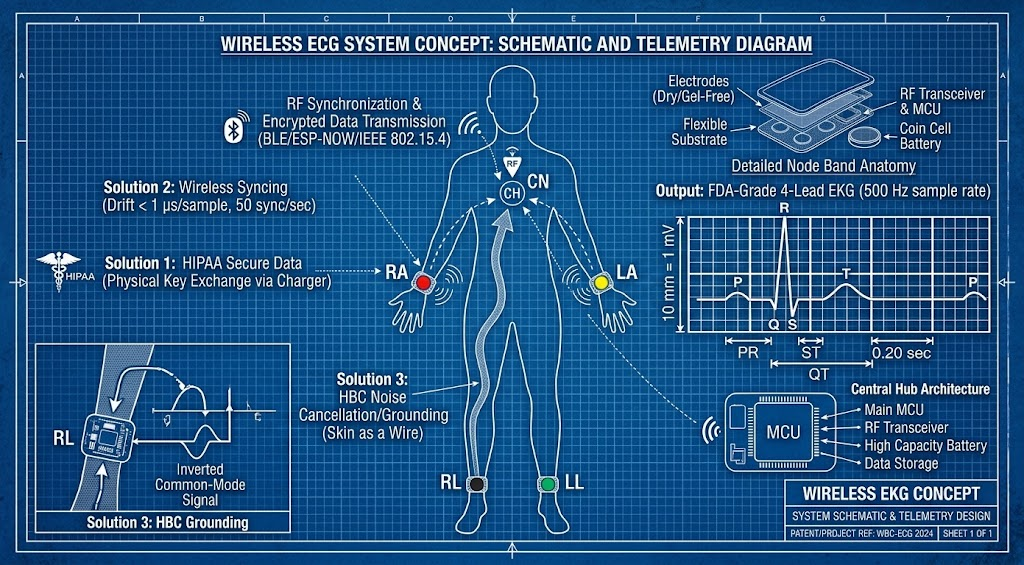
A diagram of the four-node wireless ECG, showing the limb-worn sensor bands and the hub worn by the patient
Fig. 2.3 · Four-node topology

Wireless ECG

A four-node wireless ECG: sensor bands worn on the limbs plus a hub worn by the patient, replacing the wired leads of a clinical ECG while holding the four-lead configuration and 500 Hz sampling rate that FDA approval requires. A hackathon concept study, co-authored with two teammates. The pitch deck is complete and nothing is built.

  • Did the system design and architecture, where time alignment was the hard part: an untethered node clock drifts about 50 µs every second, 13 ms across a five-minute test, which is fatal when four nodes have to agree on when a sample was taken.
  • Had the hub rebroadcast its own clock fifty times a second and timestamp each sample in hardware rather than in software, dodging interrupt jitter and holding drift under one microsecond per sample. That supports sampling above 1000 Hz and roughly 48 hours of continuous operation.
  • Solved the missing ground: a wired ECG gets its baseline from the right-leg electrode, which feeds an inverted signal back into the body to cancel ambient noise, and untethered nodes have no shared reference at all.
  • Routed that reference through human body communication, using the skin itself as the conductive path so the body closes the analog circuit and ambient electromagnetic noise cancels in real time.
  • Encrypted patient data under a key the nodes and hub exchange over a physical connection while charging, so the key never travels over the air and only the hub can decrypt.
Read the write-up →
ESP32 nRF5340 BLE / 802.15.4 RF Time Sync Sensor Networks
No. 04 Complete
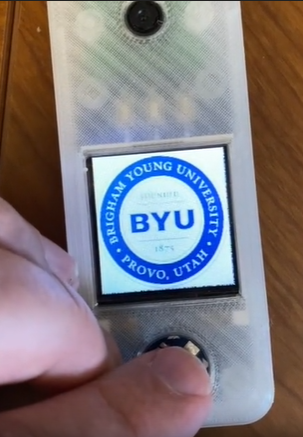
The smart doorbell running on a Raspberry Pi Zero 2W with its display and button
Fig. 2.4 · Pi Zero 2W and display

Networked Smart Doorbell

A camera doorbell on an embedded Linux target, developed entirely over SSH against Makefiles I maintained by hand. Pressing the button captures a photograph, writes it to local storage, and uploads it to a web server, with a hidden file browser reachable through a button sequence.

  • Worked around a display library that is not thread-safe: the capture and upload run on a POSIX thread while all drawing stays on the main thread.
  • Moved images off the device over TCP sockets, and wrote a systemd unit that brings the program up on boot with a delay that keeps it from fighting the display for initialization.
  • Built solo for BYU's ECEn 224 in C, on a Raspberry Pi Zero 2W, with no local editor or IDE on the target.
  • The same course covered x86-64 assembly: reverse engineering a stripped binary in GDB and objdump, and stack-based exploitation including return-oriented programming.
Raspberry Pi C POSIX Threads TCP Sockets systemd
No. 05
The Music Mood AI application showing generated album art
Fig. 2.5 · Generated album art

Music Mood AI

Generates custom album art by analyzing the mood of a song and prompting an AI image generator.

  • Analyzes audio features like tempo and timbre using Librosa and NumPy.
  • Generates a descriptive "mood" prompt from the analysis.
  • Uses OpenAI's DALL-E API to create a unique album cover.
  • Displays results in a custom GUI built with Tkinter.
Python Librosa NumPy Tkinter Pillow
No. 06 Running
The headless Ubuntu server, an old laptop running with its lid closed
Fig. 2.6 · The server

Home Infrastructure

An old laptop rebuilt as a headless Ubuntu server. It runs Jellyfin and Immich in Docker for media and photos, an OctoPrint instance for my 3D printer, and a self-hosted OpenClaw agent. Tailscale handles my own remote access, UFW rules sit at the edge, scheduled jobs cover backups and library scans, and storage is mounted and managed by hand.

Nothing here is novel. What it is good for is the part that does not show up in coursework: when a service stops at two in the morning, I am the one reading the logs.

Ubuntu Server Docker Tailscale systemd Self-Hosting

Experience

Section 03
01

January 2026 – Present

Team Lead, Summer 2026

Full-Stack Engineer & Team Lead

Moat

Moat turns equipment placards into AI-powered asset intelligence: preventative maintenance, warranty readiness, and capital planning for facilities teams.

  • Shipped ~190 merged PRs across Flutter, Go, SQL, and CI since February, roughly 20% of all mainline commits on the engineering team.
  • Built the QR-coded asset onboarding pipeline (bulk pre-printed sticker generation, scan-to-create, and re-provisioning), now used by every live customer, from Utah school districts to a luxury multifamily pilot.
  • Designed a bulk CSV asset import pipeline used to onboard large enterprise customers.
  • Built an AI-powered asset classification and replacement-cost estimation system, matching assets to divisions of construction through dual backfill pipelines. It underpins the platform's capital-planning features for every customer.
  • Hardened multi-tenant data isolation, SSO session lifecycle, and document-integrity guarantees across the platform.
  • Created a migration-ordering CI guard that was adopted as team process, protecting every production deploy.
  • Onboarded and mentored a new engineer to shipping major full-stack features within a month, reviewing 16 of their PRs as team lead.
  • Served as technical point of contact in customer meetings with school district facilities teams.
02

2026 – Present

Founder & Web Developer

Beehive Digital Solutions

Design, build, and host websites for small local businesses, with three paying clients live so far: a rental company, a florist, and a salon. The sites are hand-written HTML, CSS, and JavaScript deployed on Cloudflare Pages, with a Cloudflare R2 bucket for media and Decap CMS plus DecapBridge for content editing, so owners change their own copy and photos without touching code or waiting on me. I run the domains, deploys, and hosting alongside the design and the writing.

03

Sept 2025 – April 2026

Electronics & Firmware Lead

BYU Formula SAE Electric

Led a four-person electronics team building Project Atlas, a from-scratch control board to replace the electronics running the team's electric race car. Did the entire board layout and most of the schematic, brought the first board up and diagnosed its dead 12 V rail, and set the version-control process the team used to collaborate on hardware.

04

Jan 2025 – Dec 2025

Building Automation Programmer & Web Developer

Brigham Young University

Rebuilt an aging internal web application into a service-request ticketing system and database front end on SQL Server, so non-technical staff could file, track, and audit work without touching the database directly. On the controls side, maintained the campus HVAC system in the Niagara 4 framework and Delta Enteliweb, upgraded its graphics system, and catalogued the JACEs, controllers, BBMDs, and network drops that make remote troubleshooting possible.

05

Summer 2024

FSY Counselor

The Church of Jesus Christ of Latter-day Saints

Mentored and led groups of youth through week-long programs focused on personal development, teamwork, and goal setting.

06

2021 – 2023

Full-Time Volunteer Missionary & District Leader

Santiago, Chile

Led a team of 5 peers, setting strategic goals and conducting weekly performance reviews. Preached the Gospel of Jesus Christ. Achieved fluency in Spanish while training others in communication and planning.

07

2016 – 2021

Earlier

  • Carpenter

    2020 – 2021

    Luxury Floating Shelves Workshop

    Crafted luxury floating shelves from raw materials, from cutting and finishing through shipping. Trained new team members on fabrication techniques.

  • Head Swim Team Coach & WSI Instructor

    2017 – 2019

    Local Pool

    Led a youth swim team: daily practice curricula, meet coordination, and mentoring swimmers on technique and strategy.

  • Piano Instructor

    2016 – 2020

    Self-Employed

    Ran a small business teaching over 20 students. Built personalized curricula, managed scheduling, and organized recitals.

Section 04

Get In Touch

I'm always open to talking shop: facility intelligence, AI systems, or anything worth building. Whether you have a question or just want to say hi, feel free to reach out.

Send a Message